That funky smell coming from your leather sofa or favorite jacket isn’t just on the surface—it’s trapped deep within the material. Leather is naturally porous, almost like a sponge. This quality allows it to absorb odor-causing molecules from spills, smoke, and mildew, holding them tight within its fibers.
This is why a simple wipe-down often fails to solve the problem for good. To truly remove odor from leather, you need to understand what’s causing it and choose a method that tackles the smell at its source. Our team is here to guide you through the process safely and effectively.
Why Does Leather Hold Onto Smells?
Your leather goods readily absorb whatever is in their environment because the material is naturally permeable. While this trait contributes to the beautiful, rich patina high-quality leather develops over time, it’s also why it’s so good at hanging onto unwanted scents.
Your first step is to figure out where the smell is coming from. Pinpointing the source—whether it’s an organic spill or a chemical odor—will guide your entire cleaning process and help you choose the right solution.
The Usual Suspects: Common Causes of Leather Odors
Different smells call for different battle plans. Here are a few of the most common culprits our team encounters:
- Organic Sources: This is a big one for busy families. Spills from food and drinks, pet accidents, or even body oils can lead to bacterial growth, which causes those sour or musty smells. Mildew from storing leather in damp, dark places is another frequent offender.
- Environmental Smells: Because it’s so porous, leather easily soaks up strong airborne scents. Think cigarette smoke or heavy cooking odors from the kitchen—these can be particularly stubborn to get out.
- Chemical Odors: Sometimes, the smell comes from the leather itself, especially with new items. The chemicals used in the tanning and finishing processes can leave behind a distinct, and often unpleasant, aroma.
Our Pro Tip: The very first thing you should do is play detective and identify the source of the smell. Is it a recent spill, a long-term issue like smoke, or a chemical scent from the factory? Your answer will change everything.
The Science Behind the Smell
The global leather chemicals market is a massive industry, valued at over $10 billion, and it plays a huge role in how your leather goods are made—and how they smell right out of the box. The specific compounds used for tanning and finishing can directly influence that “new leather smell,” which isn’t always a good thing.
While the industry is making strides toward more eco-friendly solutions to cut down on harsh chemical odors, many items still retain scents from their creation. You can find more insights on the growth of the leather chemical market here. This helps explain why sometimes the best first step for a new leather bag or jacket is simply to let it air out for a few days before you use it.
Identifying Your Leather Type Before You Clean
Before you grab a cleaning cloth, you need to figure out what kind of leather you’re working with. Using the wrong product on the wrong type of leather can lead to discoloration, cracking, or a stiff, unnatural feel. Getting this step right is non-negotiable if you want to get rid of an odor without creating an even bigger problem.
Think of it this way: you wouldn’t wash a delicate silk blouse the same way you’d wash a rugged pair of jeans. Leather is exactly the same. Each type has a unique finish and level of protection that dictates what it can and can’t handle.
Uncovering Clues in Your Leather
Figuring out your leather type is easier than it sounds. You don’t need special equipment, just your eyes and hands.
Start by looking closely at the surface. Does it have a perfectly uniform, almost plastic-like sheen? Or can you see the natural grain, with its tiny pores and subtle imperfections? That uniform surface is a dead giveaway for protected or finished leather. It has a polymer topcoat that makes it much more durable and resistant to spills.
Next, get a feel for the texture. Protected leather often feels smooth, maybe even a little cool to the touch. In contrast, natural leathers like aniline feel incredibly soft, warm, and almost buttery. And then you have suede and nubuck, which have that unmistakable velvety, napped texture. These unfinished types are far more delicate and act like a sponge with liquids.
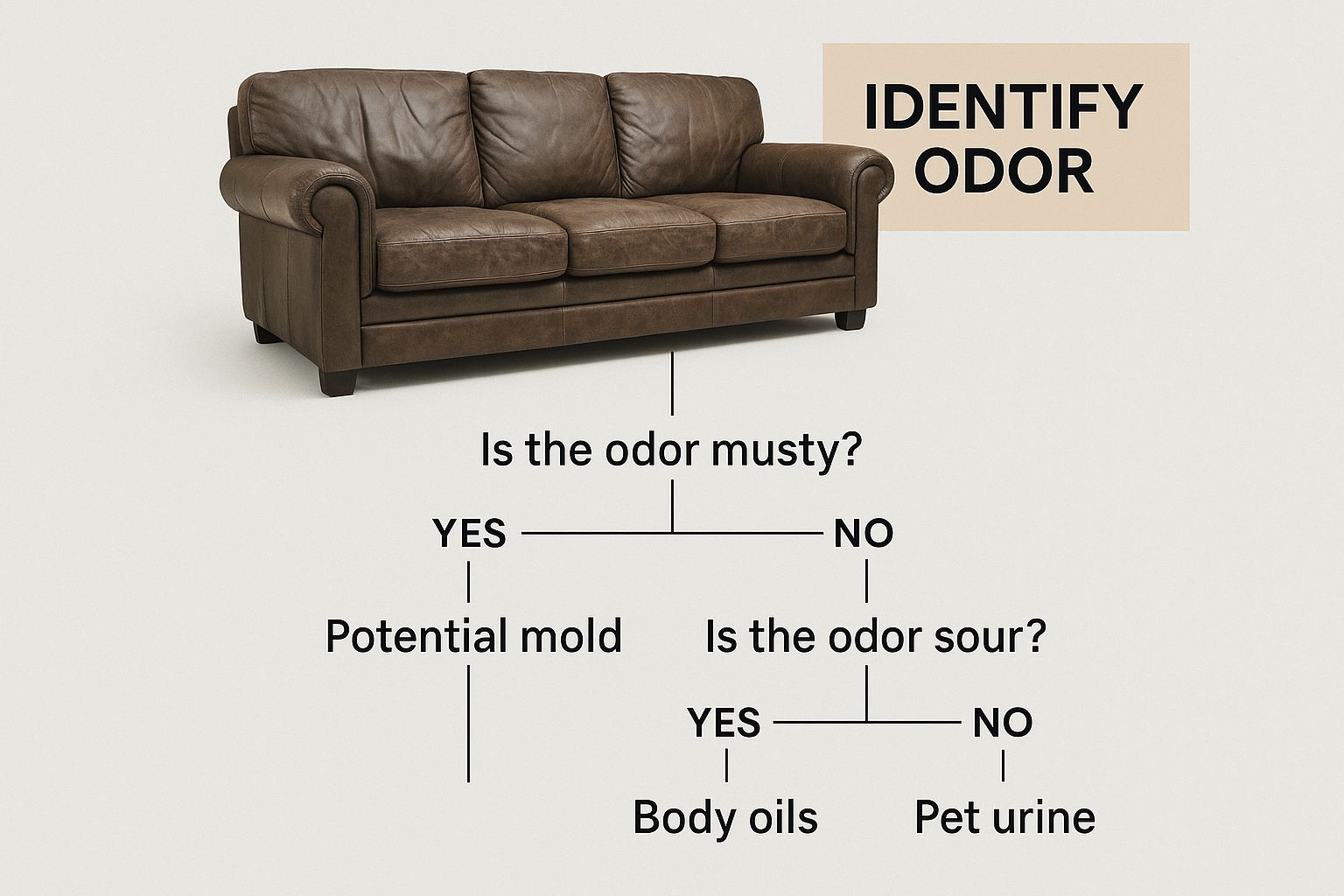
This visual guide breaks it down perfectly: your first move is always to identify the source of the smell and the type of leather before you pick a cleaning method.
The Simple Water Drop Test
If you’re still not sure, there’s one foolproof method that will give you a definitive answer: the water drop test. Find a hidden spot on your leather item—think an inside seam, under a cushion, or on the back—and place a single drop of water on it.
Now, watch what happens.
- Protected (Finished) Leather: The water droplet will bead up and just sit on the surface, refusing to sink in. This is the most resilient type of leather and can usually handle gentle, well-chosen DIY cleaning solutions.
- Aniline or Semi-Aniline Leather: You’ll see the water slowly absorb into the leather, leaving a slightly darkened spot. Don’t panic! It will dry and disappear. This type requires a much more cautious approach.
- Suede or Nubuck: The water will vanish almost instantly, leaving behind a dark mark. These leathers are extremely sensitive to moisture and almost always require specialized dry-cleaning methods.
To make it even simpler, here’s a quick cheat sheet.
Quick Guide to Identifying Leather Types
Use this table to quickly identify your leather’s characteristics and determine the best approach for care.
| Leather Type | Key Characteristics | Water Drop Test Result | Best For |
|---|---|---|---|
| Protected (Finished) | Uniform, semi-glossy finish; feels smooth and cool | Water beads up on the surface | High-traffic items like family sofas, car seats |
| Aniline/Semi-Aniline | Natural grain visible; feels soft, warm, and buttery | Water slowly absorbs, darkens temporarily | Luxury goods, items where a natural look is desired |
| Suede/Nubuck | Velvety, napped texture; soft and fuzzy feel | Water absorbs instantly, leaves a dark spot | Footwear, jackets, delicate accessories |
Taking just a few moments to perform this simple test can save you a world of headache. It protects your investment and ensures you choose a cleaning method that actually solves the odor problem without creating a brand-new one.
Understanding these differences is absolutely critical. For other tricky cleaning situations around the house, checking out our eco-friendly cleaning product guide can give you even more insights into safe and effective solutions.
Gentle DIY Methods for Everyday Odors
For those less-intense, everyday smells—like a slightly musty couch or a jacket that’s picked up some kitchen odors—your pantry might just hold the secret. Before you even think about reaching for heavy-duty chemicals, these gentle, trusted DIY methods can work wonders to remove odor from leather without risking damage.
Honestly, this is where we tell everyone to start. These solutions are both effective and incredibly safe when you do them right. The best part? They rely on simple science. No complicated formulas needed, just a little know-how and a few common household items.
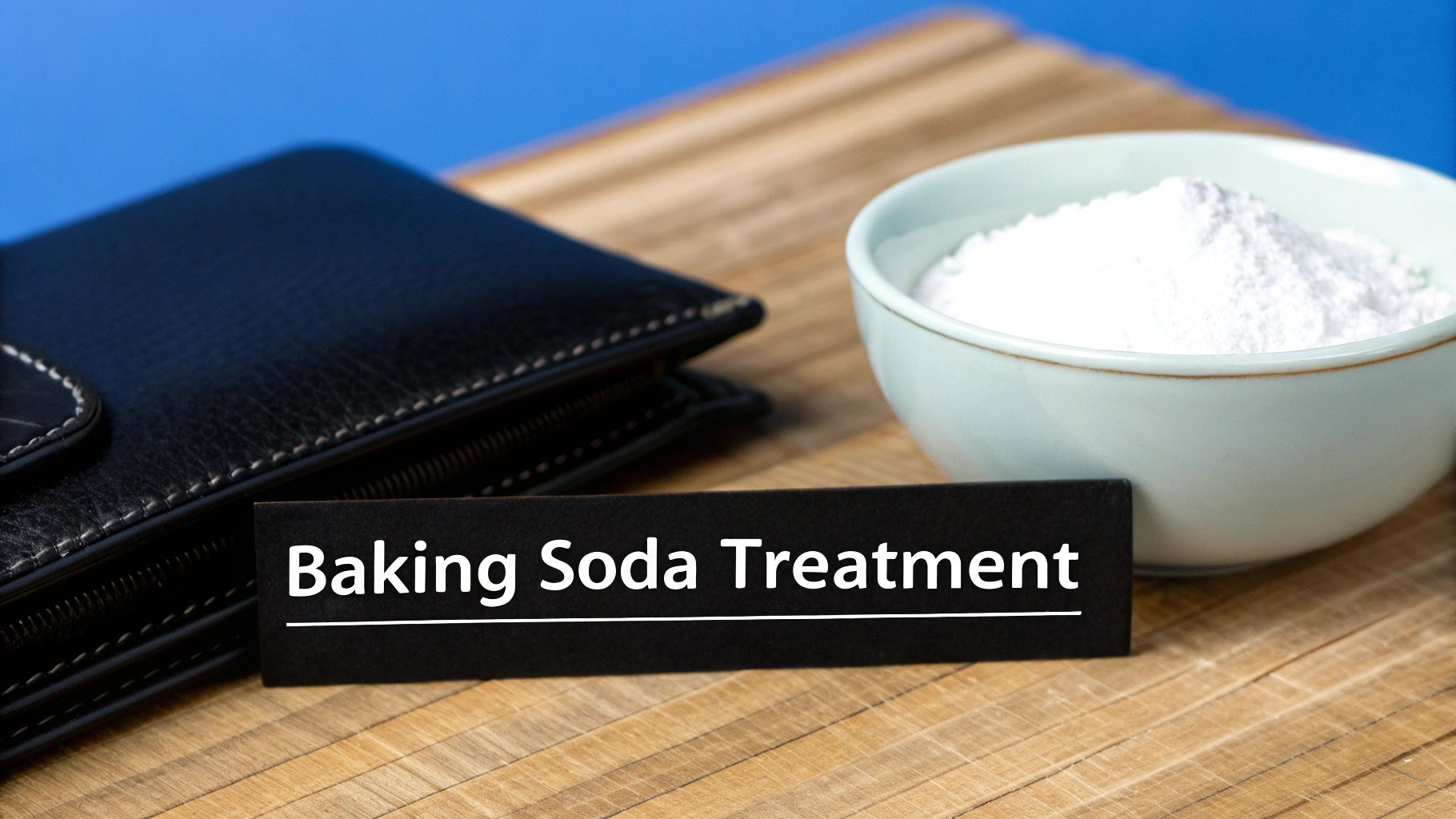
Using Baking Soda to Absorb Odors
Think of baking soda as a dry sponge for smells. Its scientific name is sodium bicarbonate, a substance that’s brilliant at absorbing and neutralizing odor-causing particles instead of just covering them up. This makes it our go-to for musty or stale scents trapped in leather furniture.
Here’s the simple process our team recommends:
- Prep the surface: First things first, give the leather a quick wipe-down with a dry microfiber cloth. You want to get rid of any surface dust or debris.
- Apply generously: Sprinkle a thin, even layer of baking soda directly onto the funky spot. Don’t be shy here—for a sofa cushion, you’ll want good coverage.
- Let it work: Now for the most important part: patience. Leave the baking soda to sit for several hours. If the smell is particularly stubborn, letting it sit overnight is even better. This gives it plenty of time to work its magic.
- Vacuum it up: Grab a vacuum with a soft brush attachment and carefully suck up all the baking soda. Using that brush attachment is key to avoiding any accidental scratches on the leather’s surface.
This trick is incredibly safe for most protected (finished) leathers, but like with any new product, we always recommend a quick spot test on a hidden area first. Just to be safe.
Neutralizing Smells with White Vinegar
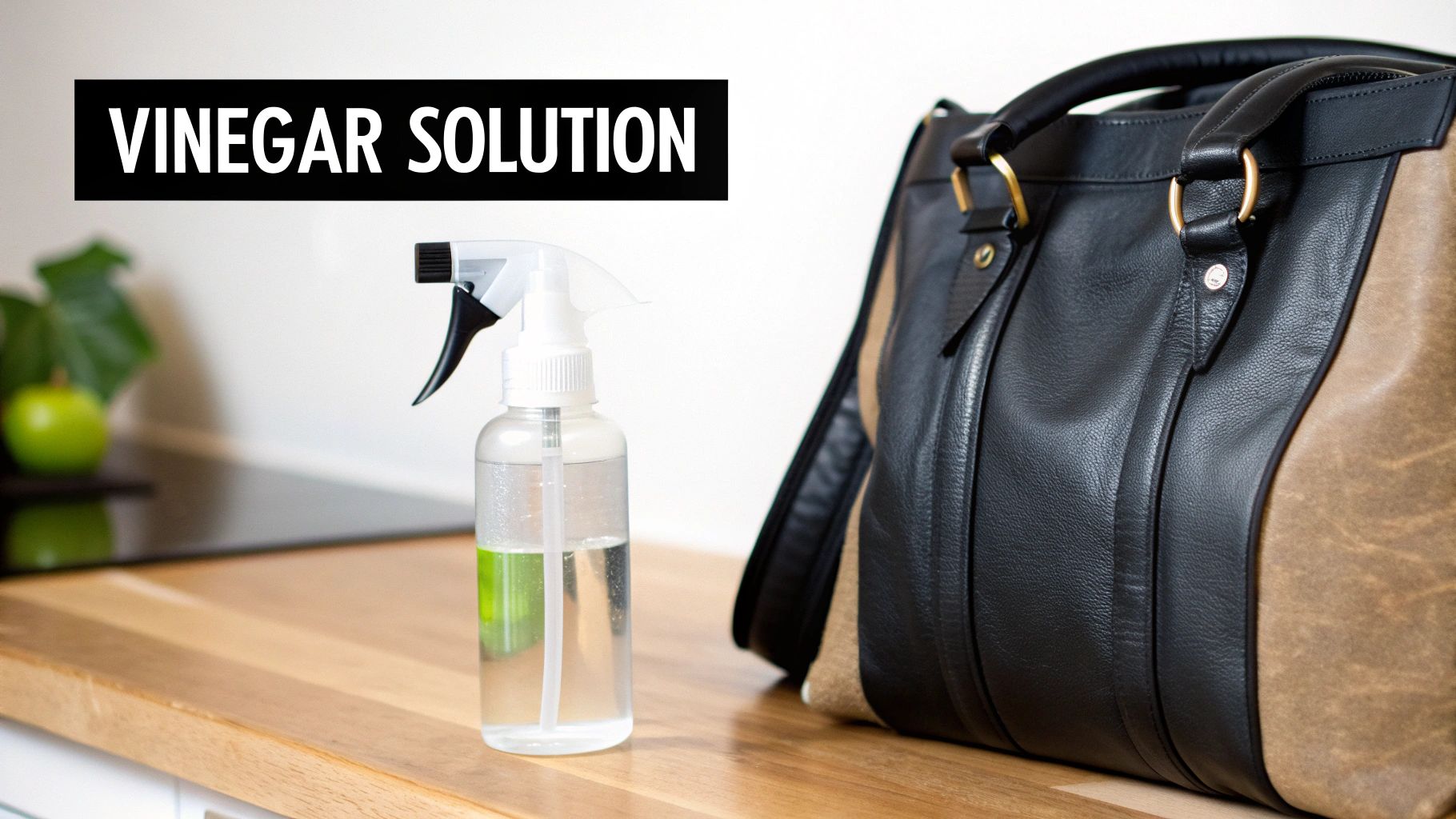
While baking soda absorbs odors, white vinegar actively neutralizes them. The acetic acid in the vinegar balances the pH of alkaline odor molecules, pretty much canceling them out. It’s especially effective against sharper, more pungent smells.
A Crucial Note: Dilution is non-negotiable here. You must dilute the vinegar. A solution that’s too strong can strip the leather’s natural oils and wreck its finish.
For a safe and effective mix, combine equal parts distilled white vinegar and water. And please, never use apple cider or other types of vinegar—they can leave stains.
- Create your solution: Just mix your 50/50 vinegar and water solution in a small bowl.
- Apply carefully: Lightly dampen a clean, soft cloth with the mixture. It should be damp, not dripping wet.
- Wipe, don’t scrub: Gently wipe down the entire surface of the leather item. An even application prevents water spots from forming later.
- Air dry completely: Let the leather air dry naturally in a well-ventilated room. The vinegar smell will be strong at first, but don’t worry. It will disappear completely as it dries, taking that unwanted odor right along with it.
The Final and Most Important Step
No matter which DIY method you choose, there’s one final step you absolutely cannot skip: conditioning. Both baking soda (which is drying) and vinegar (which is acidic) can pull some of the leather’s essential moisture out. If you don’t put that moisture back, you’re looking at stiffness and cracking down the road.
After your leather is completely dry from the treatment, apply a high-quality leather conditioner with a clean, soft cloth. Work it in using gentle, circular motions. This simple action restores the leather’s suppleness, protects its finish, and leaves it looking and feeling fantastic.
For more tips on keeping your whole home in top shape, our deep cleaning checklist is a great resource.
Tackling Tough Smells with Commercial Cleaners
Sometimes, the usual home remedies just won’t make a dent in really powerful odors like smoke, pet accidents, or deep-set mildew. When that happens, it’s time to bring in the big guns: commercial cleaners.
Stepping up to a professional-grade product can feel a little intimidating, but the right one will completely remove odor from leather without causing any harm. This is your next level of care for those stubborn smells that just refuse to fade.
The commercial leather care world is a huge market for a reason. Valued at $1.73 billion, the leather cleaner and conditioner industry is booming as more people invest in quality leather goods and want to maintain them properly. This growth is all about getting professional results at home, whether you’re working on a car interior or a luxury sofa. If you’re curious, you can discover more about leather care market trends and see just how many options are out there.
Choosing the Right Cleaner for the Job
Not all cleaners are created equal, and picking the right one comes down to the specific odor you’re fighting. Your two main options are enzymatic cleaners and specially formulated leather deodorizers.
- Enzymatic Cleaners: These are your absolute best friends for organic smells—think pet urine, spilled milk, or mildew. They’re packed with beneficial bacteria that produce enzymes to physically break down and digest the molecules causing the odor. It’s like sending in a tiny cleaning crew that eliminates the source of the smell instead of just covering it up.
- Leather Deodorizers and Cleaners: These products are typically pH-neutral formulas made to tackle general odors like smoke or mustiness while also cleaning away dirt and grime. They work on a chemical level to neutralize the smell and are often paired with conditioners to keep the leather from drying out.
When you’re reading labels, keep an eye out for keywords like “pH-neutral,” “safe for all leather types,” or “enzyme-based.” Steer clear of anything with harsh chemicals, alcohol, or acetone. Those ingredients will strip the leather’s natural oils and lead to cracking.
The Proper Application Process
Once you’ve got your cleaner, how you apply it is just as important as the product itself. Rushing this part is a surefire way to end up with splotches or an uneven finish.
Our Pro Tip: Always, always, always follow the manufacturer’s instructions. They’ve tested their product extensively, and their directions are your best guide for getting safe, effective results. Never assume one product works the same as another.
Here’s the general approach our team follows for a flawless application:
- Spot Test: First thing’s first—find a hidden spot. Under a cushion or on an inside seam works great. Apply a small amount of the cleaner and let it dry completely to make sure it doesn’t cause any discoloration or damage.
- Apply Gently: Using a clean microfiber cloth, apply the product sparingly. You never want to soak the leather. Work in small, manageable sections using a light, circular motion.
- Wipe Away Residue: After letting the product sit for the recommended time, grab a separate, slightly damp cloth and wipe away any excess cleaner.
- Condition, Condition, Condition: This step is non-negotiable. After any cleaning, you have to replenish the leather’s moisture with a high-quality conditioner. This keeps it soft, prevents cracking, and even creates a protective barrier against future smells.
For those interested in keeping a healthy home environment, you can learn more about our favorite eco-friendly cleaning products that align with a safety-first approach.
Keep in mind that some odors have been setting into the leather for years. For extreme cases, like heavy smoke saturation from a house fire, even the best commercial products might not be enough. At that point, it’s probably time to call in professionals who can offer advanced treatments like ozone generation.
Preventative Care to Keep Leather Fresh
You’ve done the hard work and managed to remove the odor from your leather. Now, the goal is to make sure you never have to go through that again. The best defense is always a good offense, and when it comes to leather, prevention is everything.
Building a few simple habits into your routine is the secret to keeping your leather furniture, jackets, and accessories smelling fresh for the long haul. This isn’t about adding a bunch of complicated chores to your list—it’s about smart, proactive care that protects your investment. A little attention now saves you a world of effort later.
Create a Simple Maintenance Routine
Consistency is your best friend in the fight against funky smells. Just like any other prized possession in your home, leather thrives with regular, gentle cleaning. This simple step removes surface-level dust, oils, and crumbs before they can work their way deep into the pores and start causing trouble.
Here’s a practical, easy-to-follow schedule that actually works:
- The Weekly Wipe-Down: Once a week, grab a dry, clean microfiber cloth and give your leather items a quick dusting. This takes maybe five minutes and prevents the buildup of everyday grime.
- The Monthly Refresh: For items that see a lot of action, like the family sofa or your go-to handbag, do a more thorough wipe-down once a month. Use a cloth that’s just barely damp with water—you don’t want to soak it.
- Quarterly Conditioning: Every three to six months, it’s time to condition. Applying a high-quality leather conditioner is non-negotiable. It restores essential moisture, keeps the material supple, and creates a protective barrier that helps repel spills and odors.
This kind of proactive care is a cornerstone of any good home maintenance plan. For more ideas on keeping your entire space in top shape, our deep cleaning checklist provides a step-by-step guide that can help you build a solid routine.
Think of conditioner as a shield for your leather. It not only nourishes the material but makes it much harder for odor-causing spills to penetrate the surface, buying you precious time to clean them up.
Smart Habits for Odor Prevention
Beyond a regular cleaning schedule, a few mindful habits can make a massive difference in keeping your leather fresh. It all comes down to tackling potential issues immediately and creating an environment where odors simply can’t develop.
Here are a few actionable tips straight from our team’s experience:
- Tackle Spills Immediately: Don’t let them sit. The moment a spill happens, blot it with a clean, dry cloth. The goal is to absorb as much liquid as possible before it has a chance to soak in and become a permanent problem.
- Give It Room to Breathe: Good airflow is critical. For large pieces like sofas, try to leave a few inches of space between them and the wall. This simple trick promotes air circulation and prevents those musty smells that develop in trapped, humid air.
- Store It Right: When putting leather jackets or bags away for the season, never seal them in plastic. That’s a recipe for mildew. Instead, use a breathable fabric bag and store them in a cool, dry place. Your leather will thank you when you pull it out next year.
Common Questions About Leather Odor Removal
We’ve covered the causes, the best methods, and how to stop odors from coming back. But our team knows that when you’re dealing with a favorite leather item, you’re bound to have some specific questions.
Here are a few of the most common ones we get from clients, answered to help you handle those tricky situations like a pro.
Can I Use Essential Oils on My Leather?
While it might seem like a great, all-natural way to freshen things up, we strongly advise against putting essential oils directly on leather. It’s a recipe for disaster. The concentrated oils can easily stain or darken unfinished leathers like aniline or suede.
Even on finished leather, essential oils don’t actually remove odor from leather—they just cover it up. A much safer bet is to put a few drops on a cotton ball and tuck it somewhere discreet, like under a sofa cushion. You’ll get the fresh scent without any risk to the material itself.
How Long Does It Take to Remove Smoke Odor?
Ah, smoke. It’s one of the toughest, most stubborn odors out there. Honestly, the timeline can be all over the place, stretching from just a few days to several weeks, depending on how bad the exposure was.
- Light Exposure: If there’s just a faint, lingering smell, a good wipe-down with a diluted vinegar solution followed by a few days of airing it out might do the trick.
- Heavy Exposure: Now, for an item that’s lived in a smoker’s home for years? You’re in for a much longer haul. You’ll likely need to repeat treatments with baking soda, activated charcoal, and probably a professional-grade enzymatic cleaner to really break down the tar and nicotine that have settled deep into the fibers.
Will Cleaning My Leather Make It Stiff?
This is a great question and a very real concern. The short answer is yes, it can… but only if you skip the most important final step: conditioning.
Cleaning agents, even the gentle, natural ones like vinegar, strip away some of the leather’s natural oils along with the dirt and smells. This is what causes that dreaded stiffness, which can eventually lead to cracking.
Always, always follow up any cleaning or deodorizing treatment with a high-quality leather conditioner. Once the item is completely dry, apply it with a soft cloth, let it sink in for a bit, and then buff off any extra. This one step is non-negotiable for keeping your leather soft, flexible, and healthy.
Is It Safe to Leave Baking Soda on Leather Overnight?
For most finished or protected leathers, leaving baking soda on overnight is perfectly safe. Since it’s a dry method, it works by just absorbing odors without introducing moisture that could damage the topcoat.
Just be sure to vacuum it all up the next day using a soft brush attachment. The bristles will help lift the powder out of the grain without scratching the surface. But a word of caution: for super delicate, absorbent leathers like suede or aniline, you absolutely have to test it on a small, hidden spot first. Better safe than sorry.
For more answers to your cleaning questions, check out our comprehensive FAQ page for expert advice.